


RC Davis Amplification
How it started -Where it's going
Robert Craig (RD) Davis freely confesses that the development of his line of guitar amps came from three inspirations: seeing the mistakes in modern design that kept crossing his repair bench, requests from friends for something simple and powerful to use for their gigs, and a memorable night watching Bill Kirchen use his Tele and a simple amp setup to play every genre under the sun. "I realized that the guys who really knew how to use their guitars wanted an amp that supported the way they manipulated tone using just the instrument. It inspired me to create an amp that wouldn't get in the way of that creativity."
While a lot of boutique amp makers start in a similar way--repairs techs modifying existing products they've been servicing, or creating clones of vintage favorites to take the place of friend's aging amps--Davis wanted his amps to have their own unique sound and to be serviceable by any capable tech. "I knew that using obsolete or proprietary parts would doom an amp to an early death, so I spent a lot of time reworking circuits to use parts that would be easily obtainable and available for a long time to come. It's foolish to pretend an amp will never need repair. What I want is an amp that rarely needs repair, but when it does, the work can be done quickly and easily by any experienced tech. I want an amp that a player can rely on, and grow to love as much as they love their guitar. That can be hard to find in an age of planned obsolescence. My plan is just the opposite - make an amp that lasts a lifetime."
In the beginning, Davis researched the best circuit designs of the past and combined them, Frankenstein style, to get the results he was looking for. Nothing was too far out to experiment with.

Fellow repair tech Sean Green lent his years of experience to help target the specific sound RD was seeking. After much player testing to refine the sound, Davis partnered with West Coast Fabrication to produce the heavy-duty steel chassis needed to support heavyweight Heyboer and Hammond transformers. Ken Moonitz--a legend in the business for his amazing woodworking skills--came onboard to develop custom cabs, including the slant front guitar amp combos still in use today. The result was the initial line of RC Davis products that included 50W and 100W heads and combos.
These first amps went through several iterations, each run mostly making minor changes in appearance.


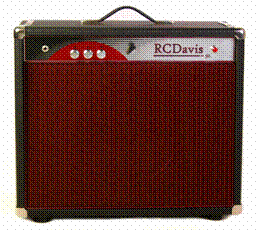
Around 2015, as interest in big amps waned and small amps began to capture the market, RD went back to the bench to design an amp that would be smaller and lighter, but still feature the unique RC Davis sound. "I didn't want my amps to be comfortable in a bedroom, though," he admits. "They're a little too much for that. I've always made amps for working musicians--players holding down weekly gigs around the city or touring smaller venues. The new amps needed to be able to stand out on stage. And they had to have my signature tone, behave in the studio, and be bulletproof on the road."
And he wanted them light. "Weight reduction was just a personal challenge," RD says. "I wanted to see how light I could get my amp without losing any tone quality or punch." Entrepreneur and guitarist Mark Infield devised the first CNC designs, allowing the use of high quality but lighter weight materials. Ken Moonitz came onboard as a consultant to perfect the cab designs and West Coast Fab once again stepped in, this time to produce a custom aluminum chassis. The result was the new lightweight Rite Spot combo amp, named for long time classic San Francisco dive bar The Rite Spot, where the amp went through months of playtime with local musicians like Bone Cootes and Lee Vilensky.


The interest in the new lightweight line quickly grew, and led to the development of two more small combos: The 30W Scirocco (Guitar Player Magazine Editor's Pick) and the latest combo, The Revotron- a tiny, mighty 35W powerhouse featuring a Celestion™ G-10 Vintage and an effects loop.


But RD hadn't given up on his higher wattage amps. After requests from pros Carl Verheyen and Ronny North, Davis relaunched a powerful new amp--the 50W Performer--at the 2025 NAMM show. It quickly became a favorite of players attending the show, with many returning to try out the amp over and over.

The Performer is currently in production, planning for a 2026 release. It will debut at the 2026 NAMM Show in Anaheim, CA.
The work to develop new products is what Davis likes best. "I've always got ideas. There's a bass amp in the works. More guitar amps. Pedals. I like what I do, and all along, I've kept meeting people who helped inspire me to create: Jim Marshall, Greg Mackie, Mark Sampson, John Quilter, Bob Gallien--they all were kind enough to talk shop with me and give me tips. Had a feel-good moment when Mark Knopfler chose my amp to play out of the lineup at the Plant. And I've been really lucky to work with local players like James DePrato and Eric McFadden to get feedback in the development stages.
Some people think tube amps are kind of old school, I guess. But there's a reason why old school works. Tube amps give something special- they're warm and romantic and forgiving. I mean, you can innovate amplification in a lot of ways, but when it comes down to it, in the relationship of guitar and amp, the guitar is the most important factor. I learned that watching Bill Kirchen. It's the instrument of communication and emotion and art. For me, the amplifier should be transparent in the presentation of that art. Besides...tubes are kind of magic. And a little dangerous. It's a great combination, in my book."
Our Partners


